A wide text generator swaps each letter for its fullwidth twin from Unicode, so “aesthetic” becomes aesthetic — the stretched look behind vaporwave captions. Type in the box above, tap a style to copy it, and paste it into an Instagram bio, a TikTok caption or a Discord status.
The same FontFancy tool runs above, opened on the wide and vaporwave styles. One detail most wide text tools skip: the fullwidth style converts letters and digits, but spaces and punctuation stay narrow. For the fully even look, copy the wide space and wide punctuation from the grid further down and drop them in by hand.
What actually changes when text goes wide
Wide text is made of different characters, not a stretched font. Unicode has a block called Halfwidth and Fullwidth Forms that holds a fullwidth copy of every printable ASCII character from U+FF01 to U+FF5E — 94 characters covering letters, digits and punctuation. They exist so Latin text lines up with Chinese, Japanese and Korean characters, which take a square cell.
| What you type | Fullwidth character | Code point | Unicode name |
|---|---|---|---|
| A | A | U+FF21 | Fullwidth Latin Capital Letter A |
| z | z | U+FF5A | Fullwidth Latin Small Letter Z |
| 0 | 0 | U+FF10 | Fullwidth Digit Zero |
| ! | ! | U+FF01 | Fullwidth Exclamation Mark |
| ~ | ~ | U+FF5E | Fullwidth Tilde |
| (space) | U+3000 | Ideographic Space |
That last row matters for the vaporwave look. An ordinary space is narrow, so wide text with a normal space looks slightly pinched in the middle. The matching wide space is U+3000, the ideographic space, and it is not part of the ASCII copy block, which is why many generators leave it out.
Fullwidth text is also not the same thing as spaced out text. “a e s t h e t i c” keeps normal letters and adds a normal space between them; it looks similar at a glance but is a different set of characters and counts differently. Both can wrap badly on a phone: spaced-out text breaks at any of its spaces, and browsers treat fullwidth letters like Chinese or Japanese characters, which may break between any two letters — so a long wide word can split in the middle of a narrow profile header.
How wide text counts toward character limits
Each fullwidth letter is a single character and a single UTF-16 unit, so a field that counts characters or UTF-16 units sees aesthetic as 9, the same as the plain word. X (Twitter) is the exception people notice: its open-source counting rules give characters outside the basic ranges a weight of two, so fullwidth text uses the 280-character allowance twice as fast.
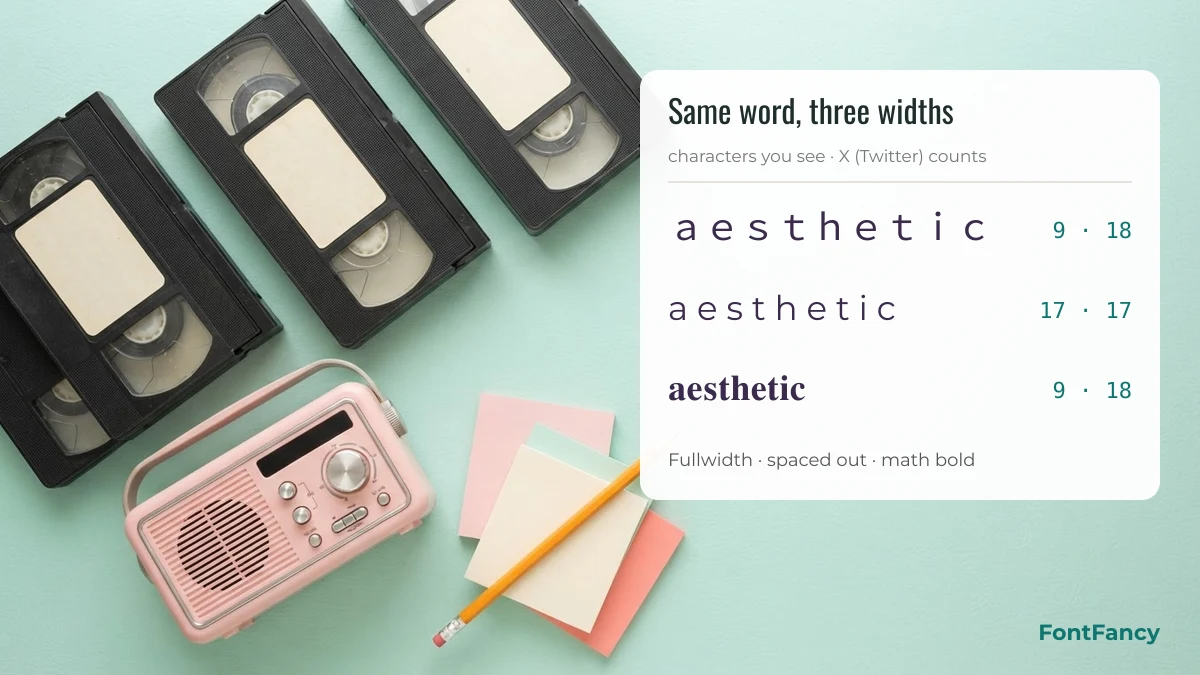
| Style | Example | Characters | UTF-16 units | X weighted count |
|---|---|---|---|---|
| Plain | aesthetic | 9 | 9 | 9 |
| Fullwidth | aesthetic | 9 | 9 | 18 |
| Spaced out | a e s t h e t i c | 17 | 17 | 17 |
| Math bold | 𝐚𝐞𝐬𝐭𝐡𝐞𝐭𝐢𝐜 | 9 | 18 | 18 |
| Fullwidth phrase | stay soft | 9 | 9 | 18 |
X counts computed with the weights published in the twitter-text configuration (v3): code points up to U+10FF and a few punctuation ranges weigh 1, everything else weighs 2. Instagram and TikTok do not publish their counting rules, so test long captions in the app before posting.
Wide spaces, digits and punctuation to copy
These are the pieces the generator does not convert for you. Put a wide space between wide words, or finish a caption with ! instead of ! so the line keeps an even rhythm.
Wide space (2)
Fullwidth digits (10)
Fullwidth punctuation (32)
Vaporwave captions ready to paste
Vaporwave began as an internet music microgenre in the early 2010s and grew into a visual style built from 1990s web graphics, glitch art, marble statues and pastel sunsets; its best-known label is itself usually written in fullwidth, AESTHETICS (Wikipedia). These captions use wide letters with a wide space between words, so they paste in exactly as shown.
Short wide captions (24)
Captions with a retro frame (8)
Kaomoji with a wide word (12)
One face and one wide word make a status line that reads at a glance. The face keeps its normal width, so the word stands out as the wide part.
Friendly faces to end a line (6)
Kaomoji stay in normal width, which gives a wide caption a softer finish.
Wide names and tags
Short names suit wide text best: four or five fullwidth letters already take the width of eight or ten normal ones, so a long name wraps onto a second line in narrow profile headers. Capitals read as a bold tag, lowercase as a calmer handle.
For a name that needs to stand out rather than stretch, round bubble letters take the same square cells with a very different mood, and monospace letters keep a terminal-style even width without the extra space.
Retro, sunset and arcade symbols
The objects of the aesthetic, grouped so you can build a scene around a wide caption: tapes and players, palms and sunsets, arcade screens and dreamy sparkles. Most are colour emoji, so their look depends on the phone brand; the line symbols such as ⏮ ⏯ ⏭ and ↻ ◁ || ▷ ↺ stay in text colour.
Tapes, players and music (24)
Sunsets, palms and ocean (28)
Arcade and grid (15)
Dreamy lines (11)
Can people still find wide text?
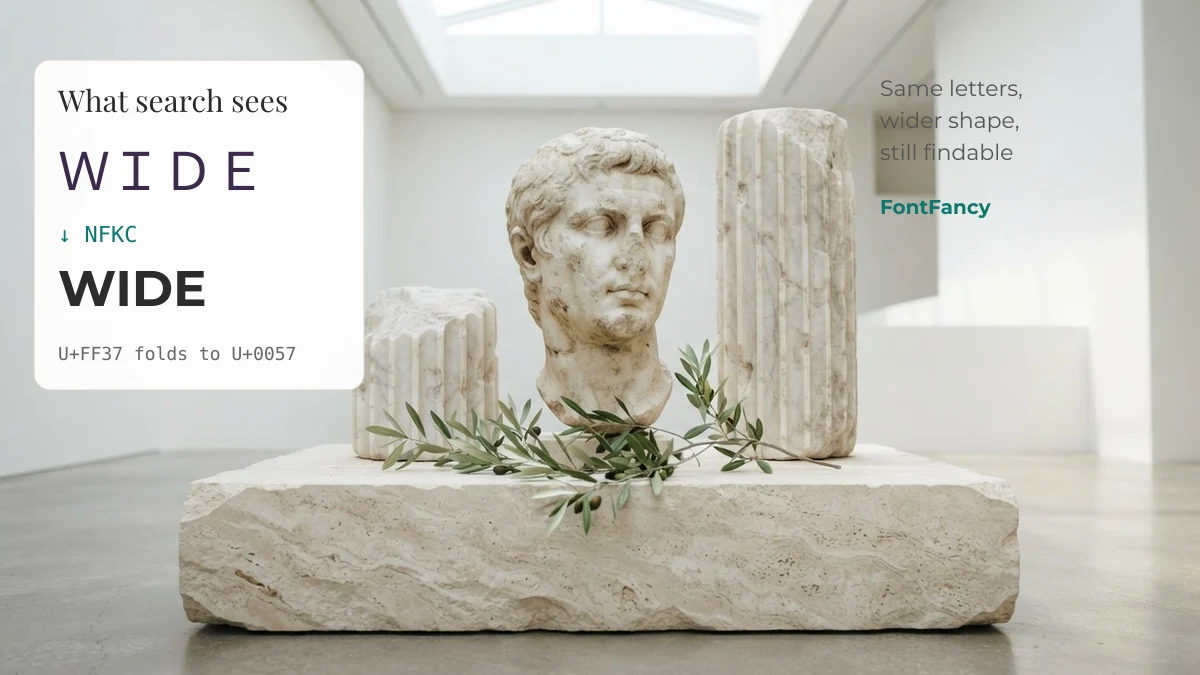
Usually yes, if the app normalises text. Unicode’s NFKC normalisation maps every fullwidth letter back to its ASCII form — w (U+FF57) becomes w (U+0077) and the wide space becomes a normal space — so search boxes that apply it match aesthetic to “aesthetic”. Apps that compare characters exactly will not, and you cannot tell which kind an app uses from the outside.
If being found by name matters, keep a plain spelling somewhere searchable, such as the @username. Screen readers are more forgiving with fullwidth letters than with maths-style letters, but reading a whole paragraph of wide text is still tiring, so keep it to a name, a heading line or a short caption. Where wide text is only one ingredient of a softer look, the aesthetic text recipes pair it with small caps and symbols, and the 2026 text style trends track which looks are rising.
Wide text questions
What is wide text called in Unicode?
Unicode calls it fullwidth. The Halfwidth and Fullwidth Forms block has a fullwidth copy of each printable ASCII character from U+FF01 to U+FF5E, and the matching wide space is U+3000, the ideographic space.
How do I make vaporwave text?
Type your words into the wide text generator on this page and copy the Fullwidth (aesthetic) style. Replace the normal spaces with the wide space U+3000 from the copy grid so every gap matches the letters.
Does wide text count as more characters?
Fields that count characters or UTF-16 units treat each fullwidth letter as one. X (Twitter) is different: its counting rules give fullwidth characters a weight of two, so a wide caption uses the 280-character limit twice as fast.
Why is there a gap between my wide words?
A normal space is narrower than fullwidth letters, so the gap looks uneven, and some tools leave a normal space in place. Use the ideographic space U+3000 between wide words for an even gap.
Is wide text the same as spaced out text?
No. Spaced out text keeps normal letters and adds normal spaces between them, while wide text replaces each letter with a fullwidth character. They look alike but count and wrap differently.
Checked on 14 September 2026: code points, names and NFKC mappings verified with the Unicode Character Database; X counting weights from the twitter-text v3 configuration; vaporwave background from Wikipedia.